
The Amalfi Coast is one of Italy’s most spectacular coastal regions.
The Amalfi Coast isn’t just a place; it is Italy in full flirtation mode. Its fifty sunlit kilometers of color, curves, and charm defines the southern Campania shoreline.
- Roads twist like spaghetti through lemon-scented cliffs. Pastel villages lean toward the Tyrrhenian Sea, as if eager to dip their toes in its shimmering blue.
- The coast runs roughly from Positano in the west to Vietri sul Mare in the east, with Amalfi, Ravello, Praiano, Minori, and Maiori nestled in between.
It’s characterized by:
- Steep cliffs plunging into turquoise waters.
- Terraced lemon groves and vineyards.
- A maze of narrow roads and ancient stone stairways linking villages.
- Unforgettable panoramas from every bend of the coastal road.
Ours was a private small group tour of the Amalfi Coast with Italy With Pleasure. Malcolm and his team know Italy like no other, and it showed! We had a memorable and enriching experience.
Amalfi Coast Itinerary
Fri, Sept 19 – Day 1: Time in Napoli
- Our flight arrived in Napoli late morning. Waiting for our ride – was a long time coming. I had messed up and did not take the time to read the pick-up time. Had to take a taxi to the hotel. This was not the start I needed.
- I soon got bewitched by the chaos and charm of the city.
- Checked-in to the hotel by early afternoon.
- Napoli hits all the senses at once – scooters buzzing, pizza sizzling, voices bouncing off stone walls. It’s wild, messy, and gloriously alive. It’s not a place of perfection but of pulse – vibrant, unapologetic, and endlessly human.
- Set between Mount Vesuvius and the Bay of Naples, it feels perpetually in motion – an orchestra of sound, scent, and life compressed into twisting alleys and sunlit piazzas. It is one of Europe’s oldest cities. It lies at the crossroads of history: Greek foundations, Roman streets, Spanish palaces, and Bourbon grandeur all layered like sediment beneath centuries of life.
- But what truly defines Naples isn’t its monuments – it’s its human energy. The people move through the streets like dancers in constant improvisation, gestures flying, words spilling fast and warm. One hears laughter, argument, prayer, and opera, sometimes in the same breath.
- Every corner feels alive, layered in noise and color.
- The air smells of frying dough and coffee, of exhaust and basil, of something ancient and new all at once.
- Laundry hangs between balconies like ribbons of everyday life, and graffiti blooms across walls as fiercely as the bougainvillea in Amalfi once did.
- There’s a rhythm here that’s untaught but unmistakable – a gritty heartbeat.
- Dinner:
- Before setting off for the Amalfi Coast, we treated ourselves to an Indian dinner in Napoli, a flavorful farewell to spices – a bold move before entering the land where carbs rule.
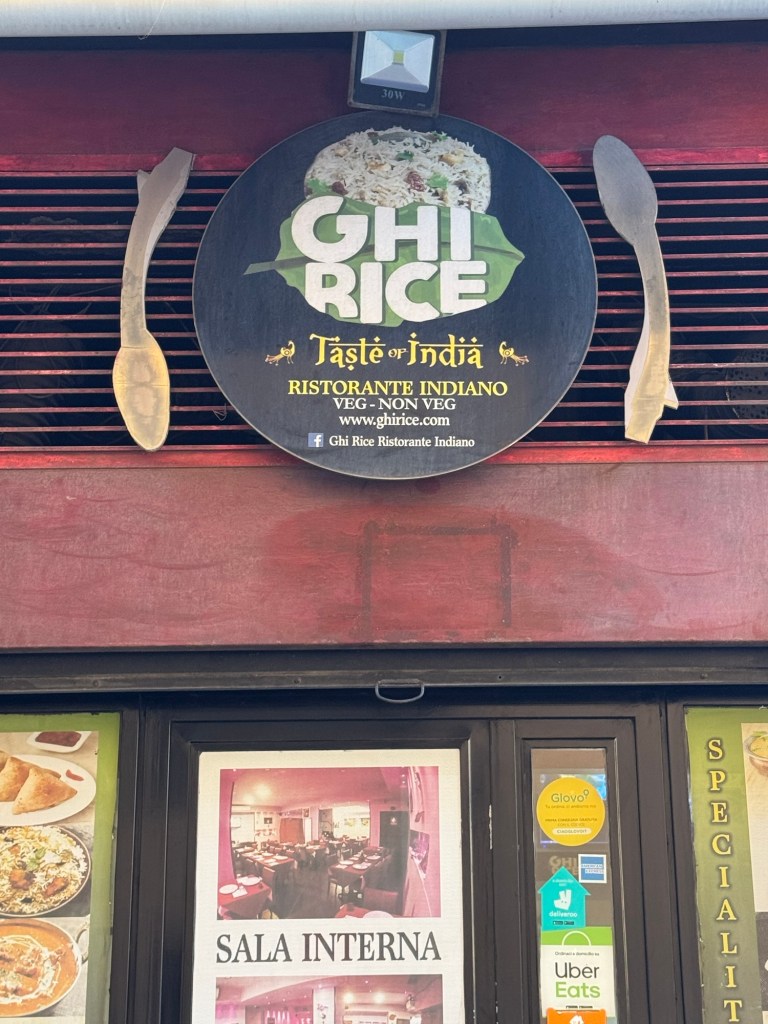
- Found a South Indian restaurant, Ghi Rice – located in the San Ferdinando neighbourhood. It was really good. We came away suitably impressed by the quality of the food, and the service.
- In Amalfi, the culinary landscape is simple: pizza, pasta, and, in case you missed it, more pizza and pasta. And always with an excellent bowl of side salad.
- Before setting off for the Amalfi Coast, we treated ourselves to an Indian dinner in Napoli, a flavorful farewell to spices – a bold move before entering the land where carbs rule.
- Overnight in Napoli
Sat, Sept 20 – Day 2: Travel to the Amalfi Coast
After breakfast, we met our guide, Paola Cioffi, from Italy with Pleasure — and with that, the Amalfi adventure was officially underway. Bags loaded, bellies full, spirits high. The caffeine was doing its job, and so was the excitement.
Little did we know that “coastal drive” would soon mean hairpin turns, heart-stopping views, and a whole new appreciation for Italian road design.
We were chasing curves, coastlines, and clichés — Amalfi, here we come.
Visit the town of Vietri Sul Mare – a gateway to the Amalfi Coast. It is world famous for its hand-painted ceramics (maiolica).
- Every wall, fountain, and storefront seems splashed with patterns of lemons, fish, and flowers.
- Marina di Vietri located below the town has a long sandy beach – rare on the Amalfi Coast – with beach clubs and cafés.
- It’s where the coast begins – and where Italy’s love affair with color never ends.
Road to the town of Amalfi – It’s the first stretch of the legendary Amalfi Drive (Strada Statale 163 Amalfitana) – one of the most scenic and thrilling coastal roads in the world.
- Travel time is approximately an hour depending on traffic, and longer if one makes the scenic stops along the way.
- The road is narrow (with limited passing space), winding and carved out of the dramatic cliffs, with the mountain hugging one side, and the Tyrrhenian Sea drops on the other. It meanders through the towns of Cetara, Erchie, Maiori, Minori, Atrani before one comes down the hill, and around the winding bend is the town of Amalfi!
- One sees the ceramic-tiled terraces in Vietri give way to lemon groves, olive trees, and waves shimmering far below.
- The air smells faintly of citrus and salt.
- Every bend seems to open up to another cinematic vista — the kind that makes one gasp in awe.
- It is a thrilling ride(!), and scooters abound!
Arrive in the town of Amalfi
- Check in to the hotel, Hotel Residence; located right smack in the center of town – right on the sea-front; Excellent location; A small, clean cozy hotel!
- Historical perspective: Between the 9th and 11th centuries, Amalfi was one of Italy’s great maritime republics, alongside Venice, Pisa, and Genoa. Amalfi’s mix of Arab, Byzantine, and Norman influences gives it a character distinct from the rest of Italy.
- It traded with Byzantium, North Africa, and the Arab world.
- It even created the Tabula Amalphitana, one of Europe’s earliest maritime legal codes.
- After centuries of storms, invasions, and earthquakes, it transformed into the serene seaside town we see today — but its proud spirit remains everywhere.
- Amalfi lives and breathes lemons — particularly its giant sfusato amalfitano variety.
- The town spills from steep cliffs to the water’s edge, a cascade of pastel façades glowing in the sun.
- Terracotta rooftops lean into one another like old friends; balconies overflow with geraniums and drying laundry that flutter like tiny flags over cobbled alleys.
- Unlike the flat seaside resorts of other coasts, Amalfi is vertical — a labyrinth of narrow lanes, staircases, and vaulted passageways that twist uphill behind the main square.
- Many homes and inns are reachable only by foot, their doors framed in stone archways worn smooth by centuries.
- Local artisans sell ceramics, limoncello, and handmade paper, each workshop tucked into alcoves where sunlight slants like gold dust.
- Climb higher, and the town reveals unexpected views — terraced lemon groves, church towers, and the endless Tyrrhenian blue beyond.
- Amalfi’s pulse beats in Piazza del Duomo, where locals and travelers converge.
- The Cathedral of Sant’Andrea commands the scene – its grand staircase rises steeply, flanked by palm trees and lined with sunlit cafés. The façade shimmers with striped stone, mosaics, and Moorish arches. From below, it feels both regal and welcoming, like a guardian watching over the town.
- Behind the grand Piazza del Duomo, Amalfi unravels into a maze of narrow alleyways – barely wide enough for two people to pass, hidden courtyards, and tiny piazzette that form the town’s secret heart.
- Whitewashed walls rise close on either side, creating a cool twilight even at midday.
- The ground beneath your feet alternates between worn cobblestones and uneven steps polished smooth by centuries of sandals.
- Arched passageways connect houses to one another, and vines trail lazily overhead.
- In these alleys, the soundscape changes — the roar of the piazza fades, replaced by the echo of footsteps, the drip of a fountain, the murmur of voices from behind open shutters. The smell of lemon zest, laundry soap, and frying garlic floats through the air.
- Every few turns, the alley suddenly widens and there it is: a tiny piazza no larger than a living room. Each feels like a stage set for daily life:
- a flower-draped balcony spilling geraniums onto the square,
- a Madonna niche glowing softly in a ceramic frame,
- or a single café table, where locals sip espresso unhurriedly.
- Amalfi’s alleys are its soul — slender, shadowed, and endlessly surprising.
- Each turn hides a story, each stairway opens to a breath of sea air, each small square holds the rhythm of everyday life lived beautifully slowly.
- Sea-front:
- Down at the waterfront, the Marina Grande bustles with ferries, fishing boats, and beachgoers.
- The harbor and Marina Grande Beach form Amalfi’s waterfront stage — busy in summer, but always picturesque.
- The sea laps just beyond Amalfi’s promenade, where you can stroll, grab a granita, or board a boat to Positano or Capri.
- Look back from the water, and Amalfi rises behind you like a watercolor — houses stacked on cliffs, the cathedral’s bell tower gleaming like honeyed stone.
- Amalfi at dusk and after dark:
- As the sun slips behind the cliffs, Amalfi exhales! The daytime bustle — ferry horns, chatter, and camera clicks — fades into a gentle hum.
- Golden light melts into pink, and the sea turns the color of brushed silver. The Duomo di Sant’Andrea catches the last rays, its mosaics flashing briefly before dusk.
- In Piazza del Duomo, the grand staircase becomes a place to sit and watch life unfold. The cafés lining the square fill with laughter and clinking glasses.
- Lamps flicker on along the promenade, and soft music and sounds begin to drift from café terraces.
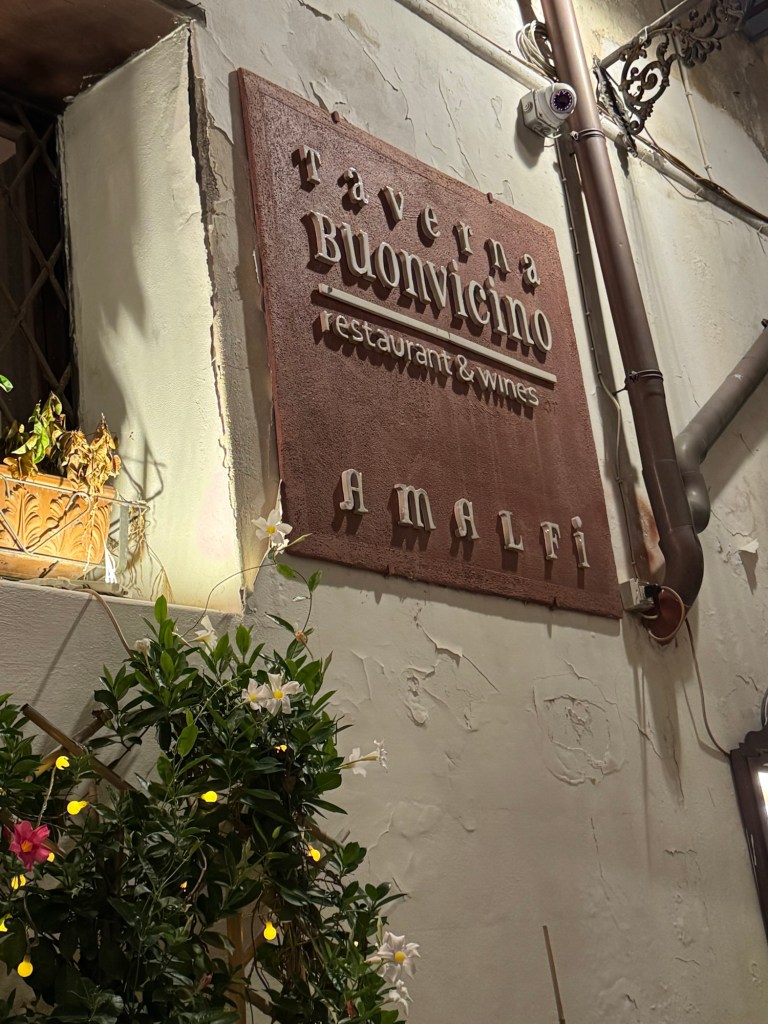
- Dinner: Italy with Pleasure treated us to an exquisite Welcome dinner at Taverna Buonvicino.
- Overnight in Amalfi.
Sun, Sept 21 – Day 3: Amalfi Coast: Wine tasting and Minori
- Morning visit to the Cathedral of Saint Andrew in Amalfi
- Visit to Tenuta San Francesco Winery in Tramonti – winery visit, tasting and lunch.
- Drive from Amalfi to Tramonti is short in distance but rich in scenery, and contrast.
- The climb from Amalfi to Tramonti is part road trip, part roller coaster on a narrow winding road.
- One moment you’re looking at the sea in your rearview mirror, the next you’re nose-to-nose with lemon trees and grapevines.
- The cliffs swap their drama for calm green terraces, and the air shifts gears — from salty spray to sweet mountain cool – scented with pine, chestnut, and crushed herbs.
- One passes little hamlets where time seems to nap — a dog in a doorway, laundry swaying like flags of everyday life. The colors shift from Amalfi’s pastel to Tramonti’s deep green, as if someone turned down the sun and turned up the earth.
- Just when you think the sea has vanished for good, the road bends, and a gate appears beside a low stone wall: Tenuta San Francesco.
- Vines older than memory stretch toward the sky, their trunks thick and gnarled, their leaves fluttering in a breeze.
- A family member greets you with a smile that feels like it’s been waiting all morning. And hands you a glass of wine — ruby, fragrant, alive — and the first sip tastes like everything the road promised: warmth, patience, and the quiet joy of arriving somewhere that still knows how to slow time.
- After a sumptuous lunch and wine, it was difficult to convince oneself to get up and head out to our next destination. Our guide Paola was both diplomatic and stern – kept us on the straight and narrow!
- A “Path of the Lemons” (Sentiero dei Limoni) beckoned! A scenic walking route, and old mule-path, connecting the towns of Minori and Maiori. By the time we got to Maiori, going up the paved parts and stairs the sumptuous lunch was long forgotten! Whilst the walk was long and little tiring, one got to experience the majestic sweeping views of the sea, the rooftops of Minori and Maiori, cliffs, and the coastal bay.
- Dinner: Our first Amalfi pizza experience? Let’s call it character-building. Soft, soggy, and entirely forgettable. I would name the restaurant, but selective memory has done me a favor.
- Overnight in Amalfi.
Mon, Sept 22 – Day 4: Amalfi Coast: Ravello – Villa Maria Cooking School with Chef Vincenzo Amatruda
- After breakfast we drove to Ravello.
- With budding chefs in our midst the excitement was palpable! – today was a cooking class to make mozzarella di bufala and a pasta dish.
- It was a beautiful sunny day in Ravello.
- With Ravello perched above the Amalfi Coast, the school had sweeping views of the terraces and gardens rather than the coastline.
- The entrance to the cooking school opens directly into the organic garden, where the air is alive with the scent of fresh herbs, basil, rosemary, mint, brushing your hands as one passes each releasing its perfume into the warm breeze. Between rows of tomatoes, peppers, and zucchini, the colors seem to hum with life. It’s less an arrival and more a gentle invitation — to breathe, slow down, and taste the landscape before you even begin to cook. Wow!, what a welcome!
- From the far end of the garden, our instructor, Chef Vincenzo, appeared with a huge big welcoming smile. As we stepped into the kitchen, the garden aromas drifted in with us.
- The Chef was warm, engaging, and deliberate in his instructions. We assisted in making mozzarella di bufala, and made pasta with zucchini, San Marzano tomatoes, and peppers, and the sauce was a mix of basil, garlic, and mint.
- Chef Vincenzo Amatruda may not be a celebrity chef, but fame has nothing to do with mastery. What he brings to the kitchen is far rarer — a deep passion for his craft, a teacher’s patience, and the kind of warmth that turns a class into a conversation. His movements are precise, his explanations clear, and his smile as generous as his portions. By the end of the lesson, you realize you haven’t just learned to cook — you’ve shared time with a man who embodies the spirit of the Amalfi Coast: humble, soulful, and utterly devoted to good food.
- It made for an amazing sensory experience!
- Dinner: Having had such a delightful lunch, dinner was anticlimactic and a non-event, at least for us.
- Overnight in Amalfi.
Tue, Sept 23 – Day 5: Amalfi Coast: Positano – Walk of the Gods
- The night before we prayed for the rain gods to keep away from Positano. Alas, the morning came and it was not to be. Because of the high probability of rain we had to cancel our Walk of the Gods.
- Drive to Positano
- The road begins in the heart of Amalfi, hugging the coastline as it winds westward. From the first curve, the world tilts toward the sea. The Tyrrhenian glitters below like liquid glass, while above you, lemon terraces and stone villas cling to cliffs as though sculpted by sunlight itself.
- Leaving Amalfi, the road threads past Atrani, then climbs and falls through Conca dei Marini and Furore, where the famous Fiordo di Furore carves a dramatic cleft in the rock — a turquoise inlet spanned by an arched bridge.
- As one continues west, the drive alternates between tunnels of stone and open stretches where the horizon suddenly explodes in blue. The air shifts from briny to floral as one passes Praiano, a quiet, romantic village scattered across the cliffs. The scent of lemon and wild rosemary follows you in waves.
- The road narrows, curls tighter, and the views grow grander. Every turn feels like a scene from an old Italian film — a Vespa zips past, a bus squeezes by with inches to spare, and the sea keeps reappearing in flashes between turns. Finally, just as the cliffs seem to run out of room, the view opens — and Positano spills into sight, tumbling down the mountainside in a cascade of color.
- Positano isn’t so much a town as it is a vision — a vertical mosaic of sun-washed houses in coral, peach, and cream, all stacked one atop another, spilling toward the sea. It’s Italy’s most photogenic daydream: vibrant, theatrical, and utterly magnetic.
- Built on the steep slopes of Monte Pertuso and Monte Comune, Positano looks as if it were painted into the cliff. There are few roads; instead, a labyrinth of staircases and narrow alleys zigzag between terraces, boutiques, and bougainvillea-draped balconies. The higher you climb, the quieter it gets — and every landing offers a view worth a postcard.
- As we were heading for lunch to a restaurant by the bay, the rain Gods decided to show their might – it was a torrential downpour! Squelch, squelch to the restaurant to dry up during lunch, and to sit tight.
- We decided to catch an early ferry back to Amalfi. Amalfi welcomed us with warm, dry open arms!
- Dinner: was pizza and salad. This time the pizza was good!
- Overnight in Amalfi.
Wed, Sept 24 – Day 6: Amalfi Coast: Capri
- Again rain was on the forecast.
- Our ferry ride to Capri was uneventful – no rain. Paola, our guide, kept checking with her contacts and found that the boat ride to the Blue Grotto was cancelled due to high waves.
- Boat ride around Capri – In place of the Blue Grotto she got us booked on a boat ride around Capri.
- The moment one leaves the Marina Grande harbor, Capri begins to reveal her secrets. The sea turns blue, blue — the kind of blue you imagine but never quite believe until you see it. The cliffs rise like ancient guardians, and their faces streaked with green and gold.
- As the boat glides along the coastline, one passes a necklace of wonders — the White Grotto, with its ghostly limestone formations; the Green Grotto, glowing like an emerald under the oars; and, of course, the fabled Blue Grotto, where sunlight bends through the water into liquid sapphire. Everywhere, the rock walls shimmer with hidden caves and sea arches that seem carved by time and imagination alike.
- Further on, the Faraglioni appear — Capri’s three stone sentinels rising from the sea. We slowed as we passed through the central arch, a ritual of good luck and romance. The captain cuts the engine for a moment — silence, save for waves tapping against the hull, gulls calling, the soft sigh of the sea. Capri feels timeless then, as if floating between myth and sunlight.
- By the time one circles back toward the harbor, one realizes that it’s not just a boat ride — it’s Capri’s slow introduction, written in light, stone, and sea.
- Anacapri … the drive from Capri Town to Anacapri is short but spectacular.
- The road winds up the western side of the island, a dramatic ribbon carved into sheer limestone cliffs. Though it’s barely 4 kilometers (2.5 miles) long, it feels like a journey between two worlds — from the bustle of chic Capri to the quiet soul of the mountains.
- Leaving Capri’s piazzetta behind, the bus begins to climb – not sure whether we went up the Via Giuseppe Orlandi or the Via Axel Munthe route. The road twists in tight hairpin turns, each turn revealing a new perspective: the turquoise sweep of the Bay of Naples below, the glint of white villas, and the faint outline of Vesuvius rising on the mainland.
- The views are heart-stopping — and so is the road itself, narrow and clinging to the cliffs, sometimes with nothing but a low stone wall between us and the sky. Buses and taxis navigate the bends with a grace born of routine, honking at corners to announce their approach. At times one finds oneself holding one’s breath then exhaling with a laugh as another panorama unfolds.
- By the time one reaches the highest part of the island, one has climbed about 300 meters (1,000 feet) in elevation — and it feels like stepping into a slower, older Italy.
- As we took a coffee break, again the rain Gods descended, this time with some vengeance, it came down really hard! Though today we were better prepared than the prior day – we had our plastic rain cover and an umbrella. Even then it was squelch, squelch time!
- Suffice to say, we did not get to see Anacapri in any meaningful way!
- Dinner: A farewell dinner by Italy with Pleasure at Da Gemma restaurant was exquisite.
- We bid farewell to our wonderful guide Paola. She was very personable, engaging, and had intimate knowledge of the Amalfi Coast. We thoroughly enjoyed our time with her.
- Overnight in Amalfi.

Thu, Sept 25 – Day 7: Pompeii and Herculaneum, & depart for Napoli
- Drive to Pompeii.
- We left the majesty of the Amalfi Coast and the lemon groves for Pompeii’s ancient stones. The coastal road twists above the sea, then softens into plains lined with olive groves and vineyards. As Mount Vesuvius appears on the horizon, the present fades, and history awaits just ahead.
- Pompeii.
- We met our guide, Ludovica, in Pompeii. She came highly recommended by Malcolm at Italy with Pleasure.
- Stepping into Pompeii is like walking through a paused world — a city frozen mid-breath on an August day in 79 AD.
- As one enters through the ancient gates, the first thing one notices is the sound — or rather, the absence of it. The modern world fades, replaced by the stone streets, the whisper of the wind, and the faint rustle of cypress trees standing guard over the past.
- The streets are still paved with basalt stones, grooved by the wheels of Roman carts.
- The houses rise around you – some simple, others astonishingly grand.
- Mosaics shimmer in the light, frescoes bloom in faded reds and blues.
- Courtyards still hold the outlines of gardens that once overflowed with roses and laurel.
- In the Villa of the Mysteries, the walls come alive with ancient color – dancers, gods, and rituals painted in detail so vivid it feels as if they might breathe again.
- Walking through Pompeii’s Forum, it’s easy to picture the life that once filled these open spaces – traders, priests, and children beneath the same wide sky.
- Now Vesuvius looms in stillness, its quiet slopes masking the force that changed everything.
- Everywhere, there’s a strange beauty — haunting yet human. The plaster casts of men, women, and even animals caught in their final moments are both heartbreaking and profoundly still. It’s a reminder that Pompeii isn’t just ruins; it’s memory made visible.
- By the time one leaves, there’s a realization that Pompeii isn’t a tragedy frozen in time; it’s a whisper from history reminding us about how fragile and magnificent life can be.
- Herculaneum (Ercolano)
- It is Pompeii’s quieter, more intimate sister city, smaller but astonishingly well-preserved.
- While Pompeii shows the scale of the disaster, Herculaneum shows its details — the colors, textures, and lives that once filled every corner.
- Compared to Pompeii’s vast sprawl, Herculaneum feels closer — almost personal.
- One descends from the modern town into a bowl of silence, the ruins lying in a hollow below street level, encircled by cliffs of hardened volcanic mud.
- When Vesuvius erupted in 79 AD, Herculaneum was buried not in ash but in a wave of molten mud and volcanic debris that sealed it instantly, preserving it with extraordinary precision.
- Wood beams, furniture, even food and fabric remain — rare glimpses of daily life caught mid-motion.
- One can still see shelves in kitchens, carbonized doors on hinges, and mosaics that shimmer as if polished yesterday.
- The streets are narrower than Pompeii’s, lined with elegant townhouses and thermal baths.
- The House of the Deer, the House of Neptune and Amphitrite, and the Samnite House retain frescoes so vivid one half expects their owners to return with wine and laughter.
- Then, by the old shoreline, there are the boathouses – rows of stone vaults where hundreds sought refuge from the eruption.
- Their plaster casts, huddled together, are heartbreakingly human – the echo of a last moment that never fades.
- And yet, Herculaneum is strangely peaceful.
- The tragedy has softened into quiet wonder – a place where history feels not distant, but close enough to touch.
- Arriving in Napoli after the serenity and cinematic beauty of the Amalfi Coast is one of those moments where the contrast is striking – not just in scenery, but in energy, sound, rhythm, and spirit.
- Dinner: Italian restaurant by the waterfront near Santa Lucia Grand Hotel.
- Overnight in Napoli.
Fri, Sept 26 – Day 8: Napoli – laundry time, sightseeing, & Pilgrimage to Pepe in Grani in Caiazzo
- After the serenity of the Amalfi Coast, Napoli feels like a jolt of electricity. The coast is harmony – light, sea, and silence, whereas Napoli is energy – sound, scent, and soul. Where one soothes, the other ignites.
- It’s chaotic, imperfect, and intoxicating. Napoli doesn’t charm you gently; it crashes into you like a wave.
- Morning in Naples felt like waking from a dream – until reality chimed in: laundry day!
- With the day open ahead of us, I found a self-wash place about ten minutes away by taxi, and off we went after breakfast.
- It ended up being a great find — the lady there was delightful, spoke great English, and offered to dry and fold everything in two hours for a small fee.
- Perfect timing! That left us just enough room for a mini-adventure in Spaccanapoli, because even laundry days deserve a little magic in Naples.
- This evening was special from the start. We were heading to Pepe in Grani in Caiazzo – a long-planned pilgrimage to the pizzeria everyone calls the best in the world.
- We arrived early, wandering toward the alley where it all happens, when suddenly, there he was – Franco Pepe himself. I called his name, half-in disbelief, and he stopped, smiling as he shook each of our hands. In that moment, any trace of “celebrity chef” vanished; he was genuine, kind, and present.
- He invited us in even before opening time, seating us in the Hall of Taste we hadn’t even booked. The team gave us a tour and treated us like family.
- The pizzas were astonishing – light as clouds, bursting with flavor. We stayed for hours, savoring every bite and every gesture of hospitality.
- The drive, the wait, the anticipation — all of it was worth it.
- Grazie, Signor Pepe!
- Overnight in Napoli
Sat, Sept 27 – Day 9: Napoli sightseeing
- Today we also had the morning to ourselves. We had a 2 hour guided tour booked for the afternoon with our guide, Ludovica. She is excellent – very personable and knowledgeable.
- After breakfast the group opted to visit the Spaccanapoli area of Napoli – we had been there the day before – visited a few places. For the afternoon, we met up Ludovica in the same vicinity.
- To walk through Spaccanapoli is to feel Naples breathing around you.
- The street slices straight through the old city like a vein of life – narrow, noisy, and endlessly alive.
- Laundry sways above your head like colorful banners; scooters hum past inches from your elbow; the air smells of coffee, frying dough, and church incense all at once.
- Every few meters, the city shifts – a Baroque chapel here, a bakery there, then a craftsman hammering copper or painting a saint’s face on a terracotta tile.
- Have tiny cafés spilling onto the street, where locals sip espresso and debate football like philosophers.
- Vendors sell lucky horns, rosaries, and souvenirs shaped like Vesuvius.
- Above the noise, the domes of San Domenico Maggiore and Santa Chiara shimmer against the light.
- Naples doesn’t separate the sacred from the ordinary – here they coexist, shoulder to shoulder, like everything else.
- A few turns westward, and we tumble into the Quartieri Spagnoli – tighter, louder, denser.
- The lanes narrow until they feel like corridors between walls of laundry and murals of Maradona.
- Voices bounce from balconies to balconies, and you feel less like a tourist and more like a participant in the city’s daily theater.
- Here, life happens in public – people cooking with windows open, children playing soccer between Vespas, neighbors shouting greetings across alleys.
- It’s chaotic, yes, but profoundly human – Naples unfiltered and proud.
- When one finally steps back into the open light, one realizes that Spaccanapoli and the Quartieri aren’t places you visit; they are experiences that happen to you.
- Dinner: Back in Napoli after our dreamy Amalfi escape, reality (and appetite) kicked in – time for our familiar fix of Indian comfort. Naturally, we made a beeline for Ghi Rice.
- Overnight in Napoli – last night!
Sun, Sept 28 – Day 10: Depart for Sicily
- Alas, all good things come to end, at some point.
- Time to say arrivederci to Napoli and the Amalfi Coast!
- Flight to Palermo, Sicily
Leave a Reply